The Physics of the Afterlife: Where Thought-Energy Goes
Let me start with a statement that sounds simple, but changes everything once you really sit with it: Thoughts are things.
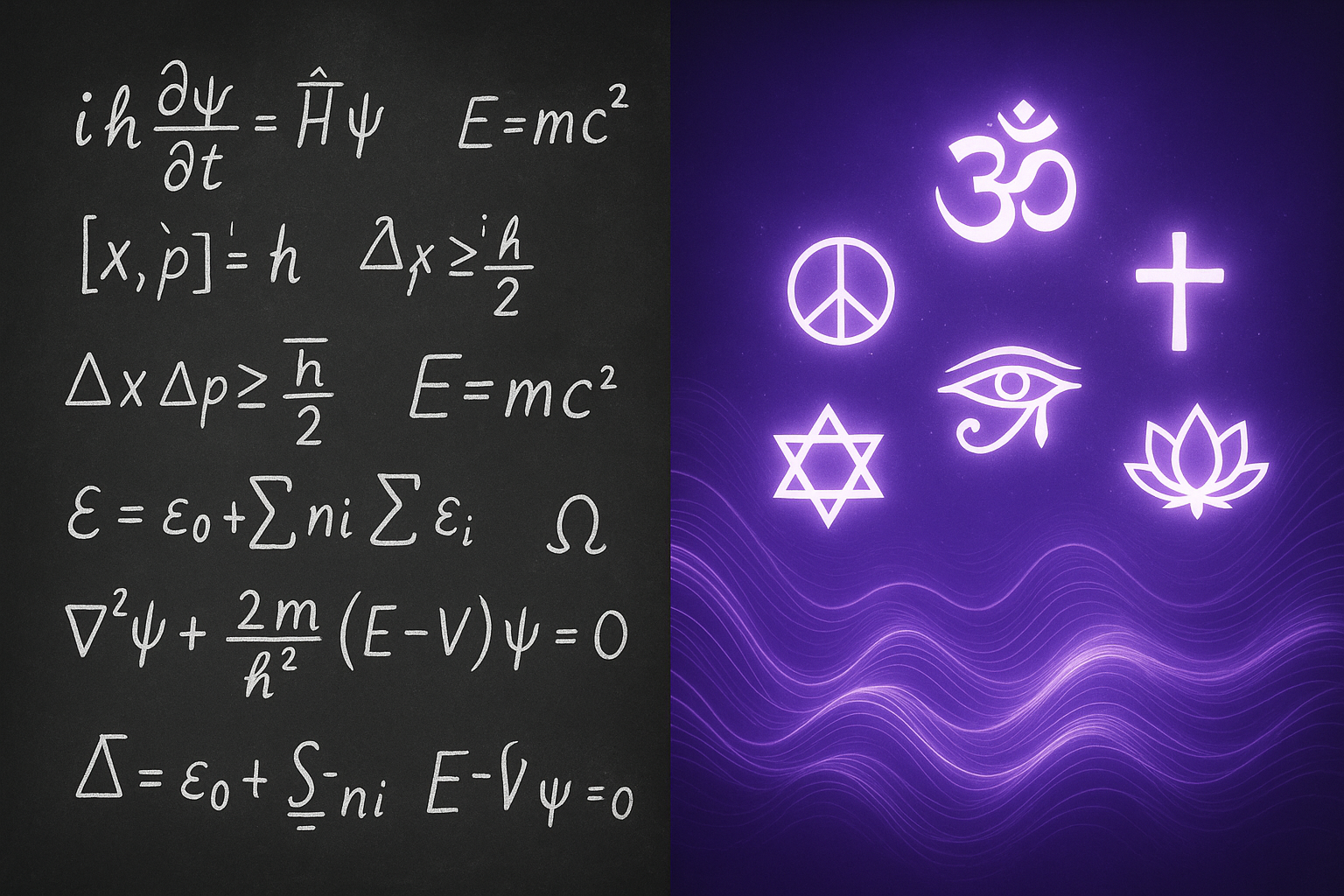
Thoughts are things.
Not “things” like a chair or a phone—but “things” in the sense that they exist. They carry weight. They shape behavior. They alter your body. They direct your choices. And most importantly: they’re not nothing.
If you can accept that thought has substance—energetic substance—then the next question becomes unavoidable:
If thought is energy… where does it go when the body dies?
This is where psychology, physics, and lived experience begin to overlap in a way most people never expect.
The Brain Is an Organ. The Mind Is an Energetic Event.
Let’s build this from the ground up.
The body needs fuel. We eat food. Food becomes energy. That energy keeps the organism alive and powers the brain—the organ. And the brain generates thought.
That chain alone is important because it establishes something most people skip right over:
Your mind doesn’t exist in a vacuum. It has an energetic origin.
So when people talk about consciousness like it’s “just an idea” or “just chemicals,” I’m always thinking: Okay… but what exactly are you claiming happens to the energy of thought? Because thought isn’t just a concept—it’s a result of energetic conversion.
Now, once you start mapping the mind, you realize consciousness isn’t one unified system. It’s multiple parts functioning together—often not in agreement.
The Mind Has Parts—and That’s Why You Repeat Patterns
If you’ve ever said:
“Why do I keep doing this?”
“Why do I react like that?”
“I know better, but I still do it…”
You’re describing the friction between the parts of your consciousness.
At a high level, here’s what that looks like:
Unconscious mind: automatic functions and default wiring—breathing, hunger, survival reflexes.
Subconscious mind: storage—memories, experiences, everything you’ve absorbed.
Conscious mind: reasoning, evaluation, present-moment choice.
Ego (sense of self): the narrator that interprets life and tries to keep you safe.
Awareness: the highest perch—the part that can observe your thoughts, emotions, and impulses.
When these parts are aligned, life feels smooth. When they’re not, you feel inner conflict. You feel “pulled.” You react before you think. You repeat what you swore you’d outgrow.
That’s not a character flaw. That’s mechanics.
And those mechanics matter—because they prove something essential:
The mind is an energetic system that produces outcomes.
Everything Is Energy (And Your Thoughts Are Part of That)
Now we take the next step.
Everything is energy.
Your body is energy organized into form. Your emotions are energy expressed as sensation and movement. Your thoughts are energy expressed as mental activity.
And here’s the practical piece most people can feel immediately:
Emotions are vibrational.
When you’re angry, you don’t just “think angry.” Your entire system shifts. Your breathing changes. Your posture changes. Your tone changes. Your focus narrows. Your body becomes a different instrument—tuned to a different station.
That’s frequency.
Your thoughts shape your emotional state, your emotional state shapes your frequency, and your frequency shapes what you perceive—and therefore what you call “reality.”
Which brings us to a line that gets misunderstood until it saves your life:
Reality isn’t “real” the way your emotions insist it is. Perception becomes reality.
Two people can experience the same event and live in two completely different worlds—because perception is the internal interpretation, and the interpretation becomes the broadcast.
The First Law of Thermodynamics Forces the Question
Now we bring physics into it.
The First Law of Thermodynamics—also known as the Law of Conservation of Energy—states:
Energy can neither be created nor destroyed; it can only be transferred or transformed.
So if thought is energy (and it is), then thought-energy cannot just vanish.
It must transfer.
It must transform.
It must go somewhere.
This is the point where most conversations about death collapse—because people want to treat consciousness like it ends when the body ends, but they don’t want to account for the energetic consequences of that claim.
If thought is energetic output, it doesn’t disappear. It disperses, transfers, transforms.
So again, the question returns:
Where does it go?
Jung’s Collective Consciousness: A Destination for Thought-Energy
Carl Jung offered language for something I believe is more than psychology. He coined the term collective consciousness—a shared field where minds connect, where thought-energy converges.
Call it a field. Call it an energetic network. Call it a structure of consciousness.
The label isn’t the point.
The point is that if thought-energy must go somewhere, then a shared “meeting place” for mind-energy is not just poetic—it’s logical.
And here’s where it becomes even more interesting.
Dark Energy: The Larger Field (And Why This Matters)
Modern science tells us that most of the universe appears to be made of something we can’t directly see—an expansive energetic presence commonly referred to as dark energy, often estimated around 69% of the universe’s total composition.
I’m not claiming the scientific community has “solved” dark energy. They haven’t.
What I am saying is this:
If there is a vast energetic field underlying reality… and if consciousness produces energetic output… and if energy must be conserved… then it makes sense that consciousness participates in a field far larger than the body.
In other words:
Your thoughts don’t end.
They are released. They disperse. They join.
And that brings us to the afterlife—not as belief, but as energetic continuation.
Death: Returning to the Field (Without Losing Individuality)
So what happens when we die?
The body ends. The brain stops converting energy into thought through physical function.
But the energy that has been generated—your consciousness-energy, your thought-energy, your lived imprint—does not cease to exist.
It returns to the collective consciousness.
It becomes one with the field again.
And this is where people get nervous, because they assume “becoming one” means losing yourself—like a drop of water dissolving and disappearing.
That’s not what I’m describing.
What I’m describing is more like this:
You remain an individual frequency within a larger field. Individuality intact. Consciousness continuing. No body—but still you.
This is what many people refer to as the higher self: consciousness without a physical form, existing within the same realm or plane of energetic reality—until it’s time to move on to whatever comes next.
And yes—this is a conclusion reinforced by my near-death experience, because I had awareness and perception outside the body. The body was the vehicle. Consciousness was the driver. The vehicle stopped… but the driver didn’t vanish.
Why This Isn’t Just “Afterlife Talk” (It’s a Life-Changer)
Here’s why I talk about this at all:
Because once you understand that thought is energy, and energy is frequency, and frequency shapes perception…
…you realize you’re not just “living life.”
You’re broadcasting a reality every day.
And if you want to permanently change your outer world, there’s one truth that never fails:
The only way to permanently change your outer world is to begin with changing your inner world first.
Not with wishful thinking. Not with fake positivity.
With awareness. With discipline. With “Press Pause.” With repeated re-training that changes your baseline frequency over time.
Because you don’t get a new life by demanding it from the universe.
You get a new life by becoming a new signal.
A Simple Reflection to Close
If this resonates, sit with one question today:
What am I broadcasting most of the time?
Not —what do you want to broadcast—what are you actually living in?
Because whatever you’re living in… you’re training.
And whatever you’re training… becomes you.
Thank you for reading—and for being willing to consider the possibility that consciousness is bigger than we ever thought.
About The Author:
Dr. Ray Catania is a celebrated educator and bestselling author known for uniting scientific understanding with spiritual wisdom. As a former atheist, near‑death survivor, and developing intuitive, Ray brings a grounded, no‑nonsense lens to the metaphysical world.
His work synthesizes quantum physics, psychology, and energetic science into a practical, evidence‑based system for measurable transformation. Ray equips seekers to confront fear, reprogram limiting beliefs, and master their thoughts to create tangible outcomes. “Apply for Private Coaching”
Ray is the creator of “Say It Three Ways,” a signature manifestation technique and online course, that anchors truths in conceivability, believability, and achievability—aligning the neurological and vibrational systems to move intentions into action.
His first book, The Atheist and The Afterlife, is the true story of his own spiritual awakening. His second book, You Are Still Alive, Now Act Like It, shares how he developed the ability to help others. Through personal experiences and scientific theories, he shares techniques that anyone can use to recreate what he’s learned.
A sought‑after speaker and coach, he guides individuals to cultivate awareness, retrain the brain, and channel emotional energy into the physical world. His Awakening Series chronicles the journey from skepticism to consciousness and offers step‑by‑step practices for living with purpose, presence, and power.
For more info visit RayCatania.Com
Disclaimer: This content is for entertainment purposes only and isn’t legal, clinical, or medical advice. If you’re dealing with a legal, medical or mental health concern, please consult a licensed professional.