

A patient lies in an intensive care unit after a severe brain injury. A doctor leans in and asks them to squeeze a hand.
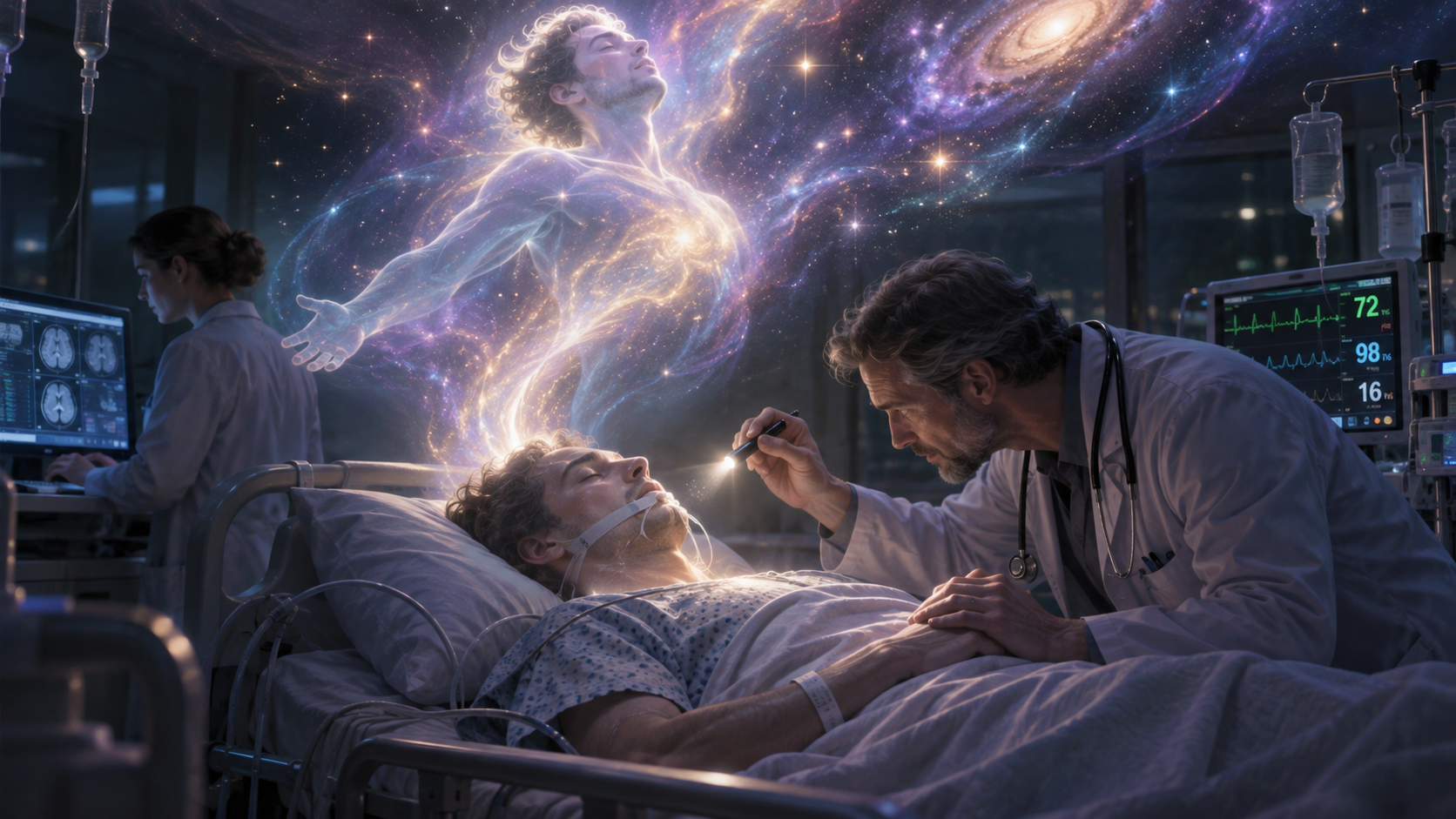
Nothing happens.
The patient is clinically unresponsive. The chart says so. The family standing at the foot of the bed can see it for themselves.
Yet, in some cases, the person lying there understands exactly what is being asked of them.
They simply have no way of telling us.
What Columbia University Discovered
On October 22, 2026, a team of researchers at Columbia University published a remarkable study in the scientific journal Brain. Led by neurologist Dr. Jan Claassen, the researchers examined 41 clinically unresponsive intensive care patients who had recently suffered severe brain injuries.
Using non-invasive EEG electrodes placed on the scalp, the researchers connected patients to a computer designed to interpret their brain activity in real time.
Through headphones, patients were instructed to alter a beeping sound by attempting to open and close their hands. Although they could not physically perform the movement, some could intentionally control the sound through their brain activity.
Thirteen of the 41 patients succeeded.
That's approximately one in three.
Nine of Thirty-Three
While one in three makes for an impressive headline, another finding is the one that particularly interests me.
Thirty-three of those patients had not demonstrated evidence of hidden consciousness through a separate assessment. Yet nine of them successfully controlled the sound using the new technology.
Think about that for a moment.
Nine individuals demonstrated an ability that previous testing had failed to detect.
Researchers refer to the phenomenon of preserved cognition without an observable motor response as cognitive motor dissociation (CMD), sometimes called hidden consciousness.
This is not an entirely new discovery. In 2019, Claassen and his team identified evidence of hidden consciousness in approximately 15 percent of clinically unresponsive patients with acute brain injuries.
The latest study also revealed an encouraging association with recovery. Four of the 13 patients who successfully controlled the computer recovered clinical consciousness by hospital discharge, compared with just one of the 28 who did not.
Although the study was relatively small and further research is necessary, the implications for patients, physicians, and families are considerable.
What the Science Shows and What It Does Not
I want to be particularly clear about this distinction.
The Columbia study does not establish that consciousness exists independently of the brain. It does not demonstrate the survival of consciousness after death, nor was it designed to investigate either of these possibilities.
What it does demonstrate is that the absence of an observable physical response is not necessarily evidence of the absence of consciousness.
There is a fundamental difference between the presence of awareness and the ability to express it.
Until we develop more sophisticated ways of detecting consciousness, we must remain open to the possibility that it is present even when our conventional methods fail to recognize it.
It is precisely this distinction that I find so fascinating.
I Have a Personal Stake in This
This is where the scientific findings end and my personal experience and metaphysical beliefs enter the conversation.
I died. I came back. I asked to return. I have written extensively about that experience in my first book, The Atheist and the Afterlife, so I will leave the details there.
As a former atheist, I spent years trying to reconcile what I experienced with what I had previously believed about consciousness and the physical body.
The prevailing scientific explanations for near-death experiences generally involve processes occurring within the brain. While I respect those explanations, I remain unconvinced that they fully account for the nature of my experience.
I have never asked anyone to accept my experience as scientific evidence, and I won't begin now.
However, research such as this serves as an important reminder that our ability to measure consciousness and our understanding of its fundamental nature are two very different things.
My Take on Awareness
In my second book, You Are Still Alive, Now Act Like It, I describe Awareness as the highest level of the human mind. It is the part of us that recognizes we are having a thought. It is not the thought itself, but that which observes it, questions it, and possesses the ability to consciously change it.
In my metaphysical model, I propose that Awareness is our true self, distinct from the egoic mind and not necessarily confined to the physical form. I also theorize that it serves as our connection to what I call the Universal Collective Consciousness. These are my philosophical and metaphysical positions, not empirically established scientific conclusions.
The Columbia research does not prove my theory. What it does, however, is reinforce one of its underlying premises: the inability to physically express consciousness does not mean consciousness is absent.
Science and metaphysics may approach the question of consciousness from different directions, but I believe there is tremendous value in allowing the two conversations to coexist.
Bringing Awareness Into Our Own Lives
Awareness is the first dimension of my Ten Dimensions of Conscious Awakening framework because everything else I teach builds upon it.
When we become aware of our thoughts, we acquire the ability to question them. When we question them, we can begin to change them. And when we change the way we think, we can begin to change the way we experience our lives.
Perhaps the most profound takeaway from Columbia's research is not simply that consciousness can go undetected, but how much we have yet to learn about something we experience every moment of our lives.
Consider those patients who demonstrated an ability to understand and follow instructions but could not physically communicate with the people around them.
We have the ability to observe our thoughts, make conscious choices, and act upon them.
How often do we take that extraordinary ability for granted?
We have Awareness, and we have another day in which to use it.
For that, I am grateful.
Scientific Sources and Further Reading
Shen, Q., et al. (2026). Clinically unresponsive patients with acute brain injury activate a brain-computer interface. Brain. Published October 22, 2026.
Columbia University Irving Medical Center (2026). A Brain-Computer Interface May Give Unresponsive ICU Patients a Voice.
Claassen, J., et al. (2019). Detection of Brain Activation in Unresponsive Patients with Acute Brain Injury. The New England Journal of Medicine, 380, 2497–2505.
The scientific research cited in this article is distinct from the author's personal experiences, philosophical interpretations, and metaphysical theories.
About The Author:
Ray Catania, Ph.D., is an author, metaphysical educator, and transformational coach who offers a modern, no-nonsense approach to personal transformation, consciousness, and the power of the mind. After surviving a near-death experience, Ray moved from atheism into a deeper exploration of metaphysics, human behavior, and the energetic power of thought. Today, he works to demystify consciousness and make transformation practical, accessible, and real.
He translates complex concepts into practical, repeatable methods that help people get unstuck, overcome fear, dissolve limiting beliefs, and become active creators of their reality. An award-winning author with a Ph.D. in Metaphysics, Ray's Awakening Series chronicles his journey from skepticism to expanded awareness, while teaching readers to master thought, elevate consciousness, and live with purpose.
His first book, The Atheist and The Afterlife, is the true story of his own spiritual awakening. His second, You Are Still Alive, Now Act Like It, shares how he developed the ability to help others. The third installment, (coming soon), expands on that journey and offers practical tools for transformation. Ray’s storytelling brings a unique voice to the metaphysical space, blending deep insight with well-placed humor, sarcasm, and wit that keep the subject matter grounded, relatable, and real. He shares techniques that many people can use to recreate what he has learned.
His work champions a simple promise: master your mind, master your reality. For more info visit RayCatania.Com
Disclaimer: This content is for entertainment purposes only and isn’t legal, clinical, or medical advice. If you’re dealing with a legal, medical or mental health concern, please consult a licensed professional.
